Field notes / competitors-buying-decisions
Google Document AI Bank Statement Parser Alternative: Compare the Operating Contract
Compare processor availability, outputs, retention, and operating responsibilities before testing Google Document AI or a specialist bank statement parser.
2026-07-24 · 11 min read · bankstatement.ai Team
TL;DR
- Fit depends on the currently documented processor, the output your accounting workflow requires, and the work your team is prepared to own.
- A general document platform may suit a team prepared to configure extraction and operate downstream workflow components. That is a decision framework, not confirmation of a particular Google capability.
- A specialist parser may reduce workflow assembly when its documented statement inputs, outputs, and processing model match the requirement.
- Neither category is universally cheaper, easier, faster, or more accurate. Commercial comparisons require current terms, while performance comparisons require controlled testing.
- Treat unverified processor availability, regional access, limits, retention, and pricing as unresolved rather than assuming parity.
Choosing between a general document platform and a statement-specific workflow is primarily a contract decision: what the service accepts, what it returns, how it operates, and what remains with the buyer. Documentation can establish that contract fit, but only an identical controlled test can establish behavior on representative statements.
Table of Contents
- Key Takeaways
- Start With Three Questions: Processor, Output, and Ownership
- Compare the Complete Processing Contract
- Map What Your Team Must Build and Operate
- What the Specialist Contract Actually Includes—and Leaves to You
- Worked Scenario: A Small Accounting Software Team
- Choose What to Verify and Test First
- FAQ
Key Takeaways
- Documentation gaps stay unresolved. An unavailable or undocumented comparison cell is a stop condition, not permission to assume support.
- Output fit and operating ownership are separate decisions. Structured JSON can still require normalization, review, and accounting-system mapping.
- Performance requires controlled testing. Documentation cannot establish accuracy, latency, reliability, or correction effort.
- Temporary results require a durable-storage plan. Buyers must preserve required outputs before an applicable expiration deadline.
- Pricing units require current sources. Do not normalize unlike billing units until each candidate’s current unit and inclusions are confirmed.
Start With Three Questions: Processor, Output, and Ownership
Category labels do not define a production-ready bank statement workflow. A platform can provide useful document-processing components while leaving transaction modeling, review, exports, or accounting integration to the buyer. A specialist service can define a narrower workflow while still leaving credential security, error handling, output review, and durable storage outside its boundary.
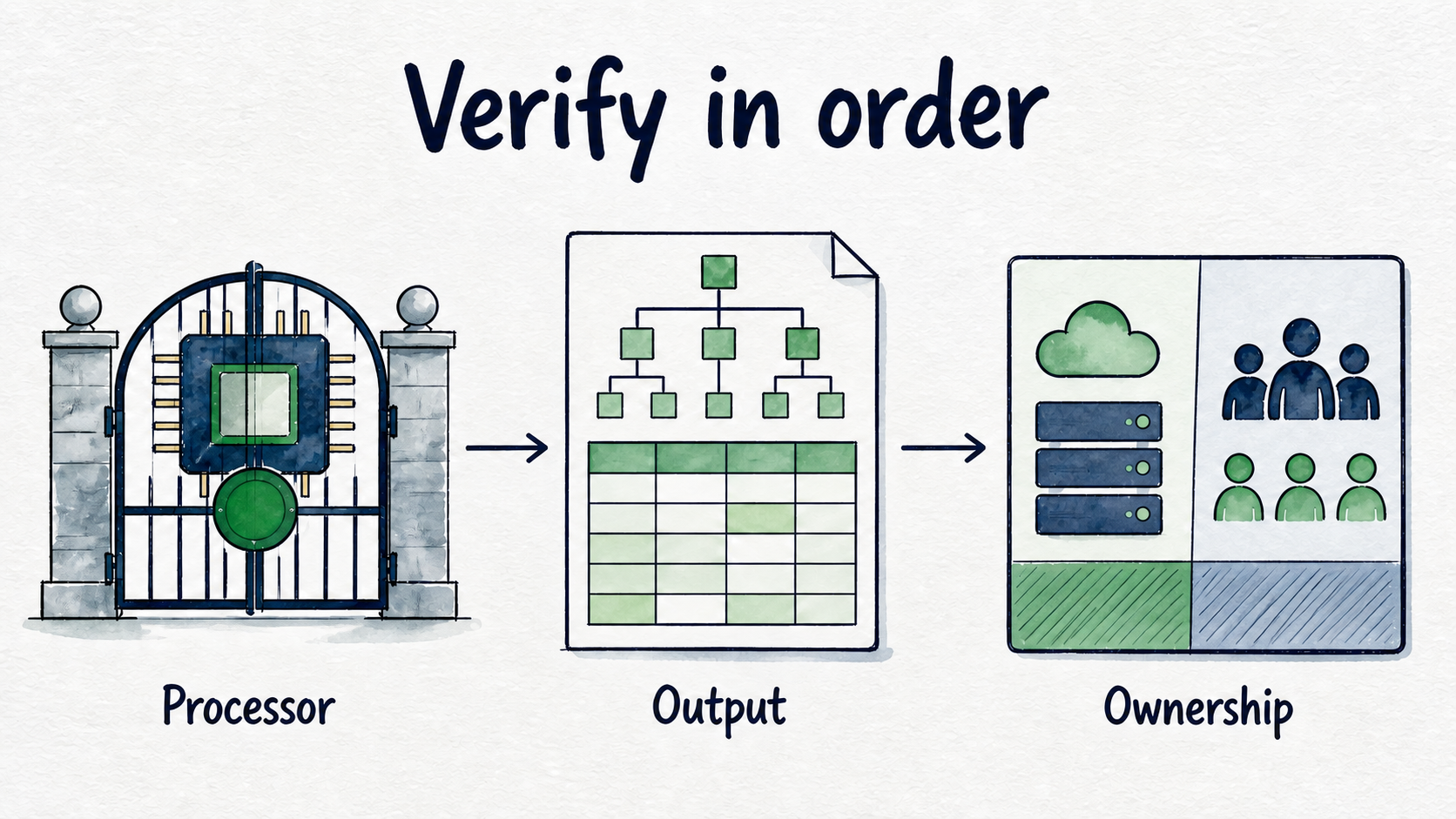
Start with three questions, in order:
- Which processor can you actually use? Confirm the processor’s current name, availability status, regions, access conditions, and authentication requirements. If any of these details cannot be confirmed in current primary documentation, availability remains unresolved.
- What must the output contract contain? Define the required JSON fields, CSV or XLSX exports, accounting-software handoff, and any invoice-collection worklist. Specify transaction fields and validation rules rather than naming only a file format.
- Who owns the remaining work? Assign extraction configuration, normalization, polling, retries, review, durable storage, and accounting mapping before estimating implementation effort.
Google Cloud Document AI is the general-platform candidate in this decision. bankstatement.ai is the specialist bank statement workflow candidate. Bank statements are the documents being processed, and REST APIs are the integration surface being compared. Current Google Cloud primary documentation is required to verify whether an applicable bank-statement-specific processor is available, where it can be used, and under what access terms.
This sequence prevents a category match from hiding a contract mismatch. A processor that extracts document content may still be suitable, but only when its verified output and the buyer-owned downstream work satisfy the frozen requirements.
Compare the Complete Processing Contract
The table distinguishes documented specialist details from Google details that require current primary documentation. “Unresolved” does not mean unsupported; it means the detail should not affect selection or scoring until verified.
| Contract dimension | Google Cloud Document AI | bankstatement.ai |
|---|---|---|
| Processor availability and access | Unresolved—current primary source required: applicable processor, availability status, regions, and access terms. | Documented source indexed July 23, 2026: specialist statement-processing API. |
| Inputs and constraints | Unresolved—current primary source required: formats, file-size limits, page limits, and statement constraints. | Documented source indexed July 23, 2026: PDF, CSV, and XLSX statements up to 25 MB. Statement converter |
| Transaction structure | Unresolved—current primary source required: schema and transaction fields. | convert targets transaction rows; documented spreadsheet rows contain date, description, and amount. |
| JSON, CSV, and XLSX | Unresolved—current primary source required: native result and export formats. | JSON results plus CSV and XLSX exports are documented. |
| Authentication | Unresolved—current primary source required: applicable authentication and client requirements. | Bearer token kept server-side; browser and mobile requests should pass through the buyer’s backend. |
| Processing pattern | Unresolved—current primary source required: synchronous, asynchronous, or batch behavior. | Asynchronous create, poll, and retrieve pattern. |
| Export behavior | Unresolved—current primary source required: formats, generation flow, and expiration. | CSV and XLSX export retrieval is documented. |
| Retention and data handling | Unresolved—current primary source required: uploads, results, metadata, data location, and regional terms. | Uploads are temporary; results, exports, and associated job metadata expire after seven days. |
| Quotas and errors | Unresolved—current primary source required: quotas, rate limits, errors, and retry guidance. | HTTP 202 indicates job acceptance, 402 indicates insufficient pages, and 429 includes retryAfterSeconds. API documentation |
| Pricing unit and inclusions | Unresolved—current primary source required: unit, inclusions, and current price. | Current verification required: confirm the published unit, allowances, and prices on the pricing page before comparison. |
The asymmetric table reflects the factual boundary: current Google primary documentation is required before its cells can be completed. That boundary supports neither a rejection of Google nor an assumption that the candidates provide equivalent contracts.
Map What Your Team Must Build and Operate
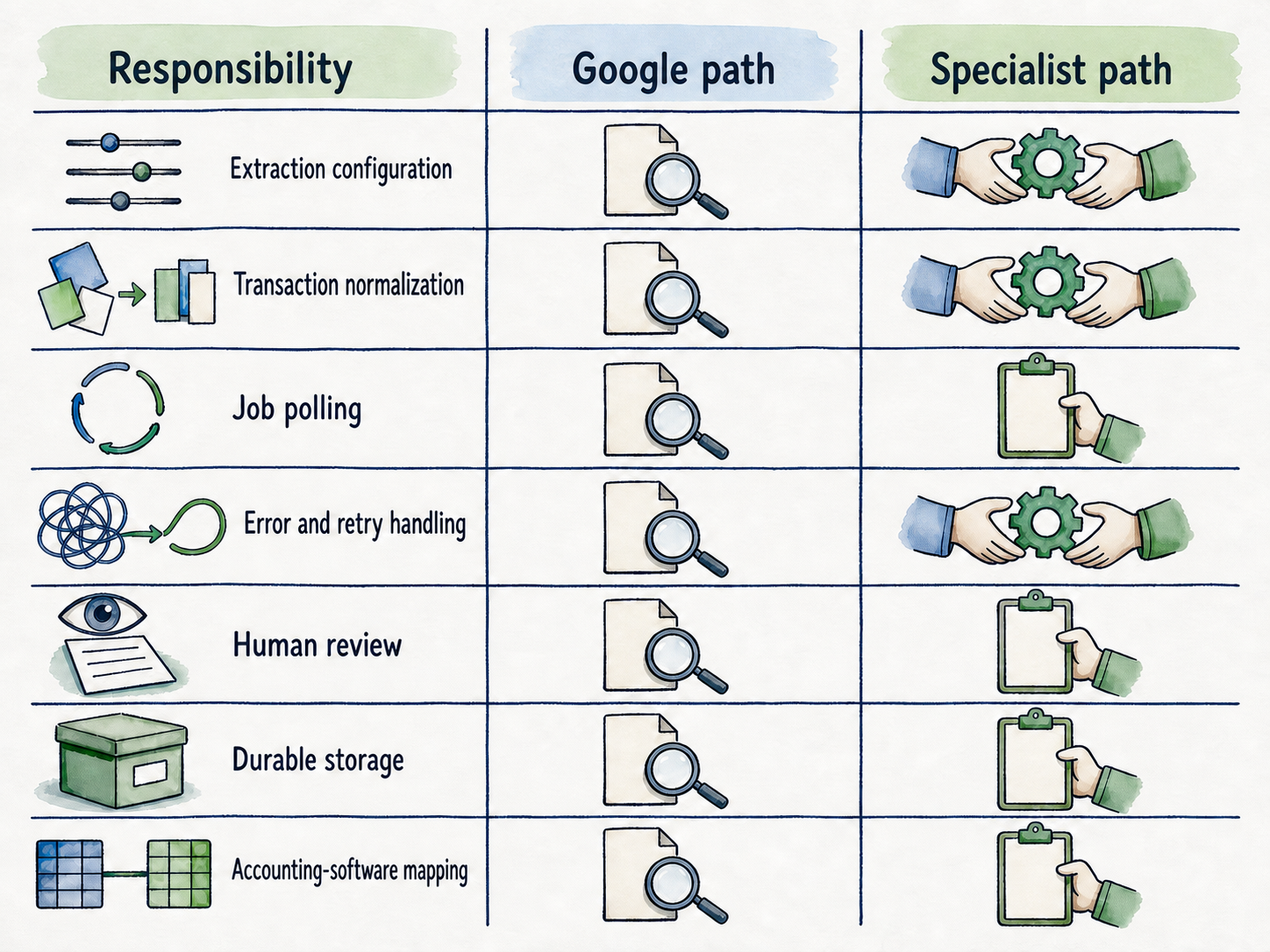
Capability describes what a service exposes. Responsibility identifies who must turn it into a safe accounting workflow.
| Responsibility | Google Cloud Document AI path | Specialist path | Required ownership decision |
|---|---|---|---|
| Extraction configuration | Unresolved until the applicable processor and configuration model are verified. | Shared: the service defines statement-processing modes; the buyer selects the appropriate mode and submits supported files. | Confirm who defines extraction behavior and handles unsupported documents. |
| Transaction normalization | Unresolved until the output schema is verified. | Shared: structured transaction rows are returned, while the buyer validates and maps them. | Define signs, dates, currencies, balances, identifiers, and duplicate rules. |
| Job polling | Unresolved until the processing pattern is verified. | Buyer-managed client logic around the asynchronous API. | Define polling intervals, timeouts, and terminal states. |
| Error and retry handling | Unresolved until error and quota documentation is verified. | Shared: the service returns documented statuses; the buyer implements retries, alerts, and insufficient-page handling. | Separate retryable failures from statements requiring intervention. |
| Human review | Unresolved until the complete Google workflow is verified. | Buyer-managed; published terms require users to review outputs before relying on them. | Set approval rules before accounting use. |
| Durable storage | Unresolved until Google retention and storage terms are verified. | Buyer-managed for records needed beyond the seven-day result window. | Move approved outputs into an authorized durable system. |
| Accounting-software mapping | Unresolved until the verified output and integration contract are known. | Buyer-managed. | Map transactions to entities, accounts, tax treatment, and import rules. |
Owner labels expose operational work without asserting that either option is inherently easier or cheaper. Cost comparison should begin only after each current pricing unit is verified and the buyer-owned responsibilities are understood.
What the Specialist Contract Actually Includes—and Leaves to You
bankstatement.ai documents a specialist bank statement workflow with two API modes. convert targets transaction rows. companies groups vendor charges and can surface sign-in or billing-page links for an invoice-collection worklist. Invoice collector
The documented inputs are PDF, CSV, and XLSX statements up to 25 MB. The API follows an asynchronous create, poll, and retrieve pattern, returning JSON results and offering CSV or XLSX exports. A bearer token must remain server-side, so browser and mobile requests should be proxied through the buyer’s backend. Job acceptance uses HTTP 202, insufficient pages use 402, and rate limiting uses 429 with retryAfterSeconds. API documentation
The data lifecycle is temporary. Completed or failed uploads are deleted after processing or cleanup, while stale incomplete uploads are removed within seven days. Results, exports, and associated job metadata expire after seven days. Required records therefore need to be transferred to the buyer’s approved durable store before expiration. Retention policy
The specialist contract does not remove buyer responsibilities. The buyer must secure credentials, operate polling and error handling, review outputs, map transactions into its accounting schema, and retain required exports. The published terms do not guarantee complete or accurate extraction, company matching, or exports and place output review with the user. Terms of Service
This documented contract does not establish guaranteed accuracy, direct bank connections, permanent archival storage, or current prices. Those points should not be inferred from the service category.
Worked Scenario: A Small Accounting Software Team
Consider a small accounting software team evaluating a synthetic PDF statement. No production customer or bank data is involved. The team freezes this required contract:
- Accept a server-uploaded PDF statement.
- Return transaction JSON containing the required accounting fields.
- Optionally provide CSV or XLSX for human review.
- Optionally create a vendor-grouped invoice-collection worklist.
- Keep authentication credentials out of the browser.
- Expose job state and actionable errors.
- Support human review and mapping into the team’s accounting schema.
- Allow approved results to be retained in the team’s authorized store.
For the specialist path, the team would select convert for transaction rows and consider companies only when an invoice-collection worklist is required. Its backend would submit the synthetic statement, poll the job, handle 402 and 429 responses, retrieve JSON, and download any required CSV or XLSX export before the seven-day deadline.
The team would still own validation, accounting mapping, human approval, and durable storage. The existence of transaction rows or a vendor worklist would not establish correctness, suitable accounting treatment, or acceptable review burden.
For Google Cloud Document AI, the applicable processor, access, region, inputs, schema, authentication, processing behavior, exports, retention, quotas, errors, and pricing unit remain unresolved until current Google Cloud primary documentation and access are verified. Only the resulting verified contract should be mapped against the same frozen requirements.
The test-first choice is conditional. Test the specialist first when its documented contract satisfies every mandatory requirement and the Google contract remains unresolved. Test both when both contracts and access are confirmed. Test neither when a mandatory input, output, security, retention, or integration requirement is not met.
Choose What to Verify and Test First
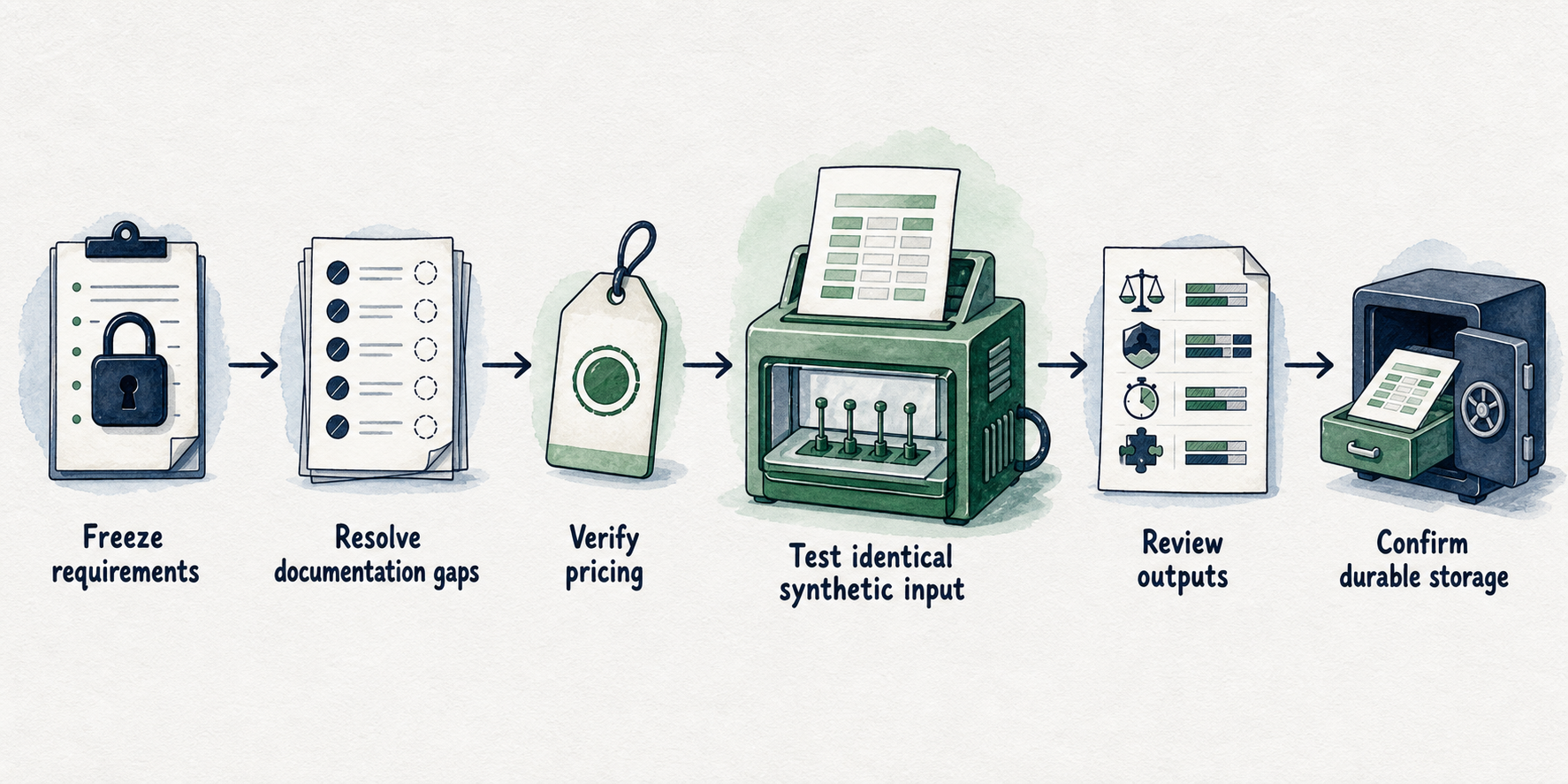
Use a short procurement sequence:
- Freeze mandatory input, output, authentication, retention, and workflow requirements.
- Resolve every Google documentation and access gap before scoring that path.
- Verify each candidate’s current pricing unit, inclusions, limits, and prices before normalizing cost.
- Run the same synthetic input through every accessible candidate.
- Review outputs before any accounting use, measuring correctness, failure behavior, latency, and human correction effort separately.
- Confirm where approved data will be retained after temporary processing ends.
The published API testing guide explains how to evaluate identical authorized fixtures with frozen ground truth. For the specialist path, compare the API contract, review the current pricing page, create an account if the contract fits, and test only with a synthetic statement before considering production data.
FAQ
Is Google Document AI confirmed to provide a bank statement processor in my region?
Current Google Cloud primary documentation is required to confirm whether an applicable bank-statement-specific processor exists, its availability status, supported regions, and access terms. Until those points are verified, they remain unresolved.
Can documentation prove which option is more accurate or faster?
No. Documentation can establish the documented contract, including inputs, outputs, authentication, limits, and operating terms. Accuracy, latency, reliability, and review burden require an identical controlled test for each accessible candidate.
Who owns durable storage?
For bankstatement.ai, the buyer must retain any required results or exports because they expire after seven days. Storage ownership for a Google path remains unresolved until current retention and storage documentation for the applicable processor is verified.
Can API tokens be used in a browser?
The bankstatement.ai bearer token should not be exposed in browser or mobile clients. Keep it server-side and proxy client requests through a backend.
Does companies mode replace accounting review?
No. It creates a vendor-grouped invoice-collection worklist and can surface sign-in or billing-page links. It does not guarantee the vendor match, invoice, amount, or accounting treatment, so the output still requires review.
How should pricing be compared?
Compare each candidate’s current documented billing unit, included processing, limits, overage behavior, and expected workload. Do not assume that per-page, per-document, or any other units are equivalent; normalize them only after current primary sources establish the applicable units and inclusions.