Field notes / competitors-buying-decisions
Build vs. Buy a Bank Statement Extraction API: Who Owns What?
Choose a build, buy, or hybrid bank statement extraction model by checking contract fit, assigning workflow ownership, documenting evidence, and testing both paths fairly.
2026-07-31 · 14 min read · bankstatement.ai Team
TL;DR
- Buy or pilot an API when it passes every mandatory contract gate and extraction is not a durable product differentiator.
- Build when essential control, supported formats, security boundaries, or workflow behavior cannot be obtained from a verified provider—and your team can sustain operation after launch.
- Use a staged hybrid when OCR and transaction extraction can be purchased while review, accounting mapping, deduplication, reconciliation, and durable storage remain product-specific.
- Do not assume that any path is cheaper, faster, safer, more flexible, or more accurate. Compare documented contracts first, then measure both paths with identical synthetic or properly authorized statements.
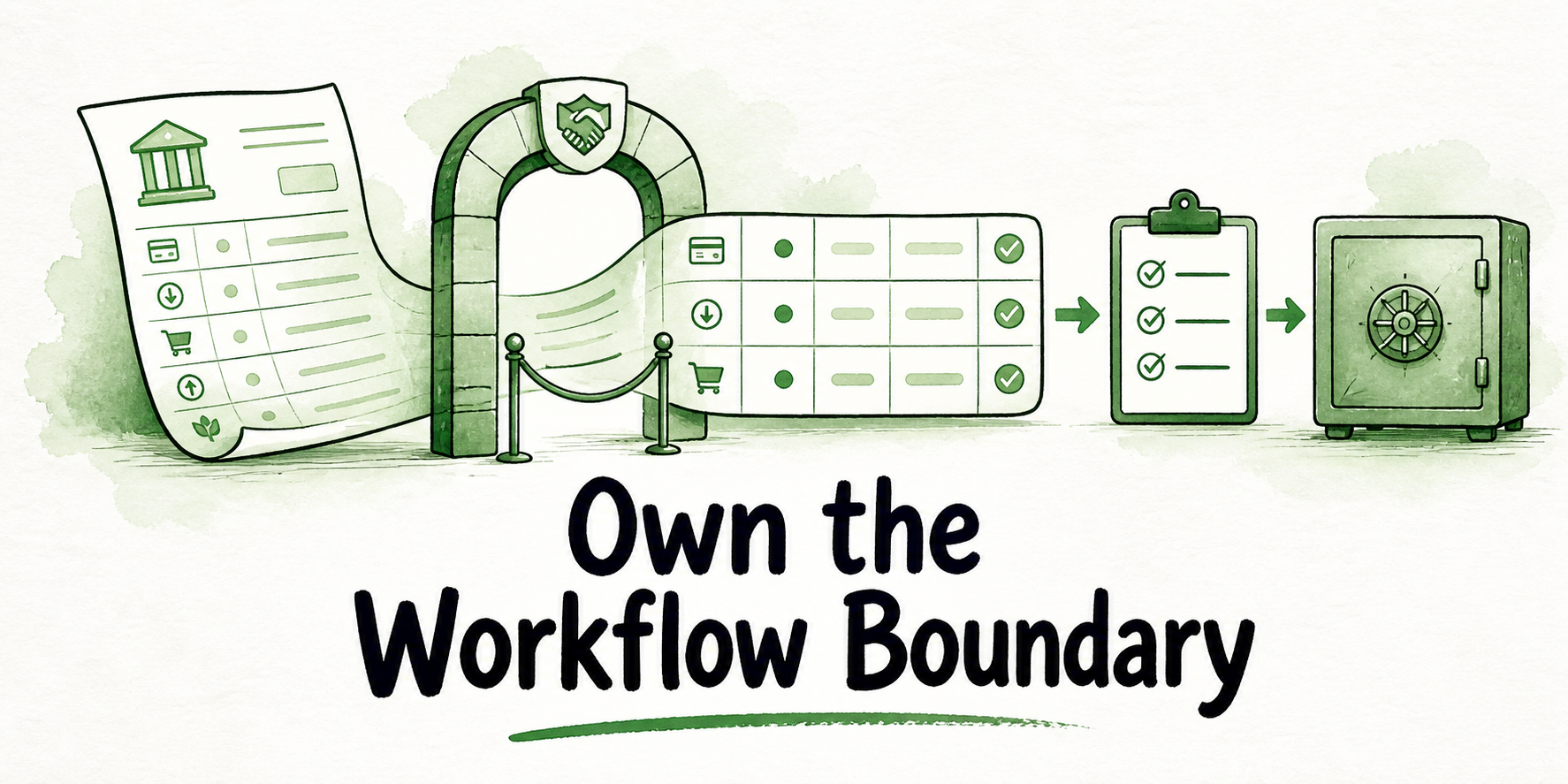
A small accounting software team is rarely deciding only who should write an OCR component. It is deciding who will own malformed files, layout changes, retries, questionable rows, accounting mappings, retention, security, and support incidents month after month. The right operating model is the one whose complete responsibility boundary matches the team’s requirements and capacity.
Table of Contents
- Key Takeaways
- Define the System Before Choosing Who Builds It
- Set Mandatory Contract Gates Before Comparing Cost
- Map Responsibilities Across Build, Buy, and Hybrid
- Apply the Framework to the Documented API Contract
- Build a Cost Model From Your Own Inputs
- Worked Decision Record for a Small Accounting Software Team
- Run the Same Proof of Concept on Both Paths
- Record the Decision and the Conditions That Could Change It
- FAQ
Key Takeaways
- Contract fit comes before cost comparison. Price cannot rescue an option that fails a mandatory security, retention, input, output, or workflow requirement.
- Keep documented behavior, buyer requirements, observed test results, inferences, and unresolved questions separate. They are not interchangeable forms of evidence.
- Buying extraction does not automatically transfer responsibility for human review or the handoff to accounting software.
- Durable storage is a separate system decision. A JSON, CSV, or XLSX result is not necessarily a retained, reconciled accounting record.
- Assign every operational task to an owner before approving a build, buy, or hybrid path.
Define the System Before Choosing Who Builds It
Start by separating the layers often compressed into the phrase “bank statement parser.” Bank statement OCR reads document content. Transaction extraction turns that content into structured fields such as date, description, and amount. Normalization then applies the buyer’s required types, signs, descriptions, and account-specific rules.
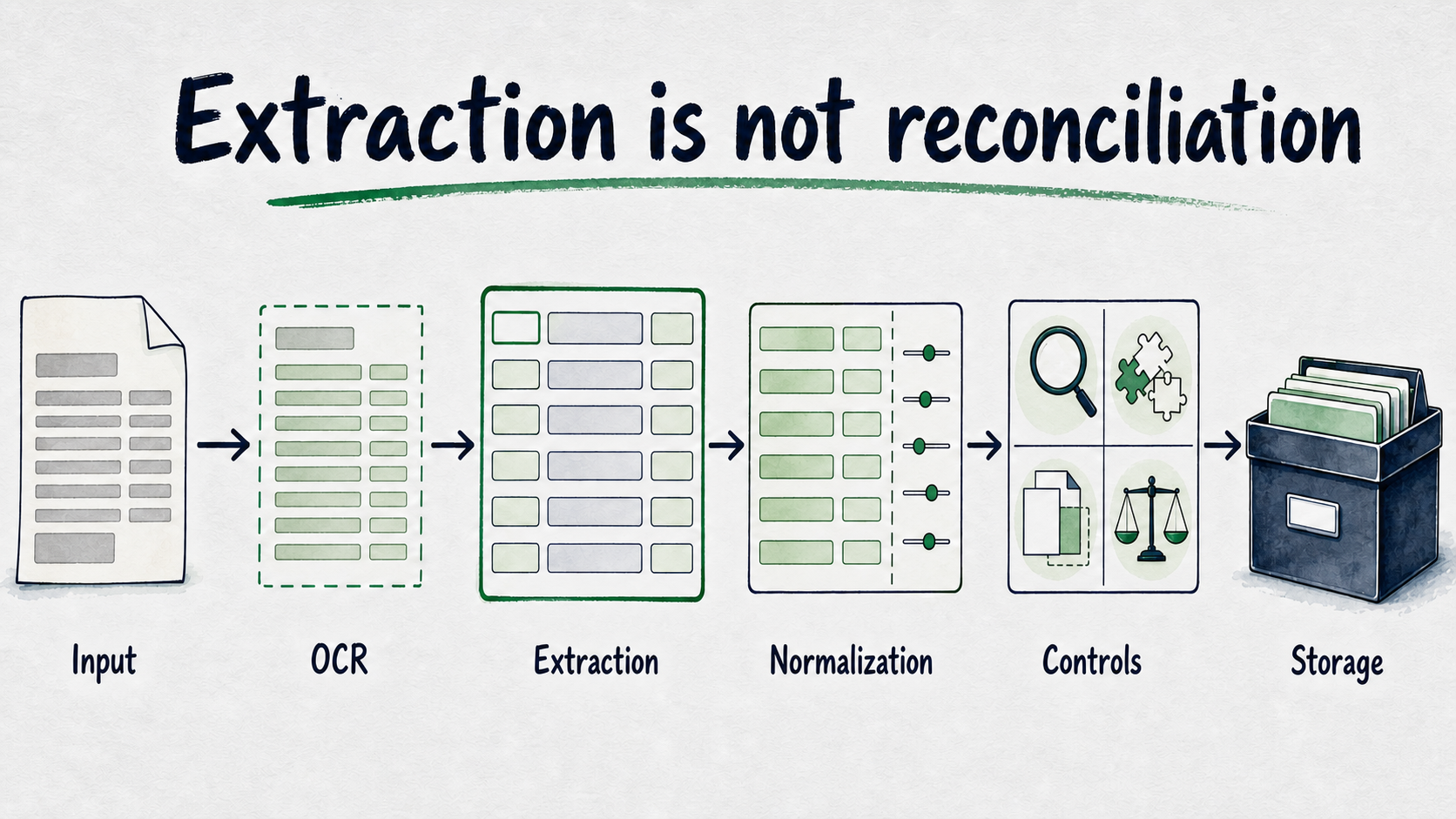
Inputs also matter. A PDF may require OCR or layout interpretation. CSV and XLSX files are already structured, but they can still contain inconsistent headings, merged cells, repeated balances, or bank-specific conventions. Outputs may include JSON for a REST API workflow or CSV and XLSX files for spreadsheet users.
None of those outputs is automatically reconciled or accounting-ready. Accounting software still needs the correct account mapping, duplicate controls, review status, and import behavior. Human review may be required for ambiguous rows or exceptions. Durable storage must preserve approved records for the required period independently of temporary extraction results.
An invoice-collection worklist is another downstream product, not merely a different file format. It can group charges by company and help a finance team locate invoices or billing pages. Decide whether that workflow belongs inside the product before including it in the extraction requirement.
Set Mandatory Contract Gates Before Comparing Cost
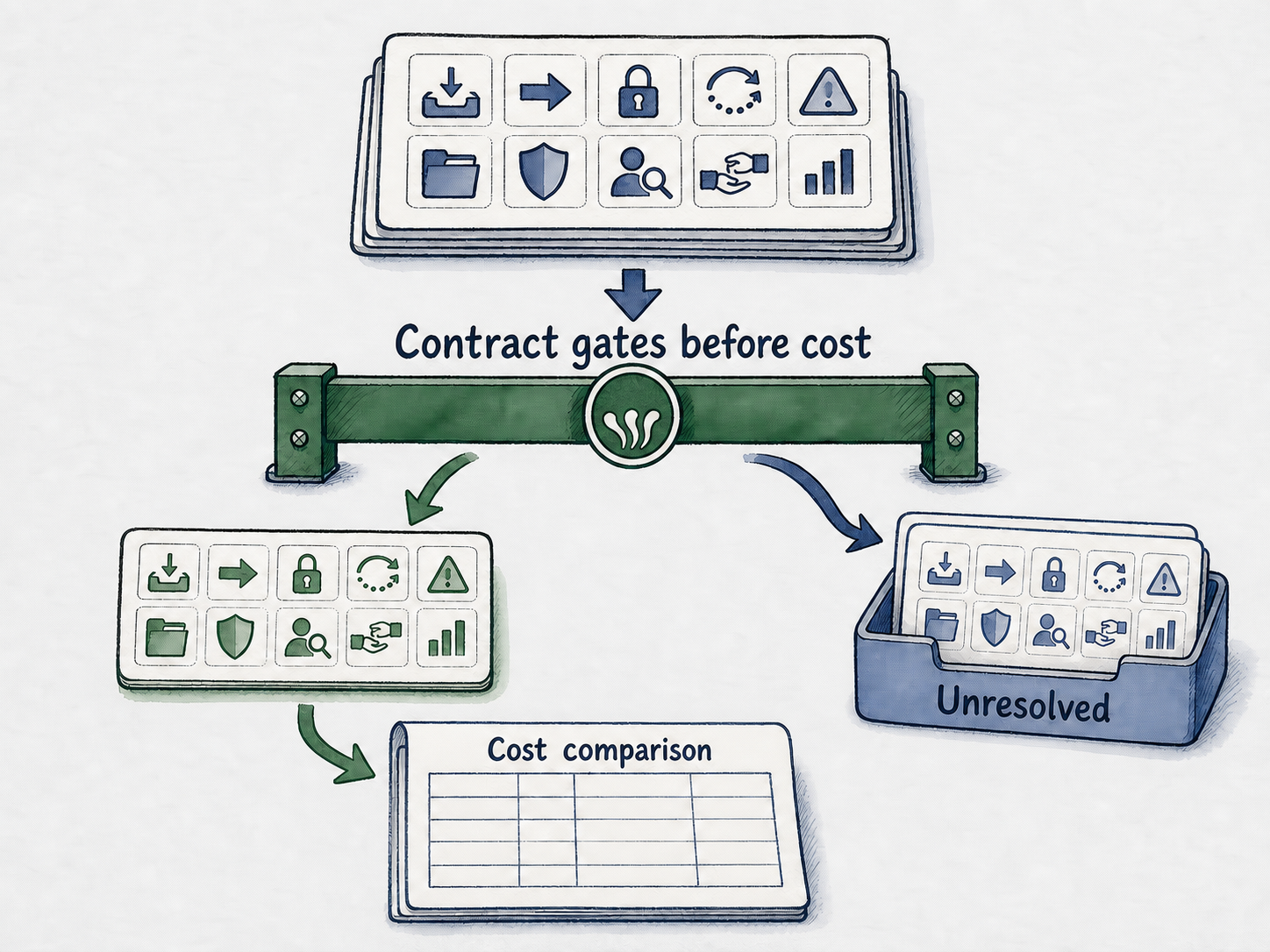
Write pass/fail gates from the workflow the team must operate. Do this before estimating engineering effort or comparing a provider’s pricing unit.
- Inputs: Must the system accept PDF, CSV, and XLSX? What file-size, encryption, scan-quality, language, and layout constraints apply?
- Outputs: Which transaction fields are mandatory? Do consumers need JSON, CSV, XLSX, or all three? What schema and type guarantees are required?
- Authentication: Can credentials remain on a trusted backend? Are browser or mobile uploads part of the design?
- Asynchronous behavior: Can the product support job creation, polling, completion, failure, and expiry states?
- Errors: What behavior is required for HTTP 402 insufficient-page responses, HTTP 429 rate limits, timeouts, partial failures, retries, and duplicate submissions?
- Retention and deletion: How long may uploads, results, exports, and metadata exist? When must deletion occur? Where will approved records be stored durably?
- Security boundaries: Which buyer-approved security, legal, regulatory, data-residency, subprocessor, incident-response, and compliance requirements apply?
- Human review: Which rows require verification, who handles exceptions, and who approves the final data?
- Accounting handoff: Who maps accounts, prevents duplicate imports, reconciles totals, and posts or exports approved records?
- Usage: What are the expected and peak monthly page volumes? Is usage measured by page, document, job, or another unit?
Record an unanswered gate as unresolved—neither a pass nor a failure. Unknown buyer policies must also remain unresolved until the appropriate owner supplies them.
Map Responsibilities Across Build, Buy, and Hybrid
Ownership-matrix date: August 5, 2026. This is a decision template based on the supplied evidence, not a universal allocation for every provider. Re-date it whenever requirements, contracts, or test results change.
Evidence-status labels used below are documented fact, buyer input, observed result, inference, and unresolved gap. No proof-of-concept observations were supplied, so no matrix entry is classified as an observed result yet.
| Responsibility | Build | Buy | Staged hybrid | Evidence status by entry |
|---|---|---|---|---|
| File intake and validation | Buyer | Contract-dependent | Buyer boundary plus documented provider validation | Build: buyer input; Buy: unresolved gap; Hybrid: inference |
| OCR | Buyer | Provider if contracted | Provider if contracted | Build: buyer input; Buy: inference; Hybrid: inference |
| Baseline transaction extraction | Buyer | Provider if contracted | Provider if contracted | Build: buyer input; Buy: inference; Hybrid: inference |
| Normalization | Buyer | Contract-dependent | Buyer rules applied to provider output | Build: buyer input; Buy: unresolved gap; Hybrid: inference |
| Layout-change handling | Buyer | Provider only within verified contract scope | Provider extraction changes; buyer regression checks | Build: buyer input; Buy: unresolved gap; Hybrid: inference |
| Asynchronous polling | Buyer | Buyer’s API client | Buyer’s API client | Build: buyer input; Buy: documented fact for the evaluated contract; Hybrid: documented fact for the evaluated contract |
| Retries and idempotency | Buyer | Buyer unless verified otherwise | Buyer unless verified otherwise | Build: buyer input; Buy: unresolved gap; Hybrid: unresolved gap |
| Output verification | Buyer | Buyer | Buyer | Build: buyer input; Buy: documented fact; Hybrid: documented fact |
| Exception review | Buyer | Buyer unless verified otherwise | Buyer | Build: buyer input; Buy: unresolved gap; Hybrid: buyer input |
| Final human review | Buyer | Buyer unless a verified contract transfers it | Buyer | Build: buyer input; Buy: documented fact; Hybrid: documented fact |
| Accounting mapping | Buyer | Buyer unless a verified contract transfers it | Buyer | Build: buyer input; Buy: documented fact; Hybrid: documented fact |
| Deduplication | Buyer | Buyer unless a verified contract transfers it | Buyer | Build: buyer input; Buy: documented fact; Hybrid: documented fact |
| Reconciliation | Buyer | Buyer unless a verified contract transfers it | Buyer | Build: buyer input; Buy: documented fact; Hybrid: documented fact |
| Observability and incident response | Buyer | Shared boundary to be verified | Shared boundary to be verified | Build: buyer input; Buy: unresolved gap; Hybrid: unresolved gap |
| Credential and data security | Buyer | Shared boundary to be verified | Shared boundary to be verified | Build: buyer input; Buy: unresolved gap; Hybrid: unresolved gap |
| Durable storage | Buyer | Buyer unless a verified contract transfers it | Buyer | Build: buyer input; Buy: documented fact; Hybrid: documented fact |
“Documented fact” in this matrix means the allocation is supported within the supplied evidence for the evaluated contract; it does not establish that every provider uses the same boundary. “Buyer input” records a responsibility assigned by the buyer’s proposed operating model. “Inference” is provisional and must not be treated as contractual. An “unresolved gap” requires contract evidence or a buyer decision. After testing, add dated “observed result” entries without replacing the documentation or requirements they were measured against.
Apply the Framework to the Documented API Contract
For a concrete application, bankstatement.ai documents a REST API using server-side bearer tokens. Tokens should not be exposed in browser or mobile clients; requests from those clients should pass through the buyer’s backend. Jobs are asynchronous: the client creates a job, polls its state, and retrieves the result or export after completion.
The documented convert mode produces transaction rows, while companies mode produces invoice-collection worklists. Results are available as JSON, with CSV and XLSX exports. The API contract identifies HTTP 402 for insufficient pages and HTTP 429 with retryAfterSeconds for rate limiting. These are documented interface behaviors, not observed performance results. See the API documentation.
The statement workflow accepts PDF, CSV, and XLSX files up to 25 MB and extracts date, description, and amount rows for spreadsheet-oriented workflows, according to the converter page. The separate invoice-collection workflow groups charges by company and surfaces sign-in or billing-page links.
Retention is a decisive ownership boundary. The documented policy says completed or failed uploads are deleted after processing or cleanup, while stale incomplete uploads are removed within seven days. Structured results, exports, and associated job metadata expire after seven days. Teams needing longer retention must move approved data into their own durable system before expiry. Because the policy includes qualifications and exclusions, evaluate the complete data-retention policy against the buyer’s requirements.
Within the supplied evidence, there is no evidenced public accuracy benchmark and no evidenced processing-time SLA for bankstatement.ai. That does not demonstrate poor performance; it leaves two questions unresolved until the buyer obtains contractual clarification or records proof-of-concept results.
The supplied evidence also does not establish a permanent archive, direct bank connection, guaranteed accuracy, unlimited use, or an enterprise plan. Durable storage, downstream mapping, deduplication, reconciliation, and final review remain buyer decisions unless a verified contract explicitly transfers them. The service’s Terms of Service also assigns users responsibility for reviewing output before relying on it.
Build a Cost Model From Your Own Inputs
Compare the same workflow scope on both sides. Leave every unsupported cell blank rather than filling it with an industry estimate.
| Cost input | Internal build | Purchased or hybrid path |
|---|---|---|
| Initial implementation time | ||
| Integration and workflow implementation | ||
| Ongoing maintenance | ||
| Infrastructure | ||
| Durable storage | ||
| Human review labor | ||
| Failed-job investigation and reprocessing | ||
| Expected monthly pages | ||
| Peak monthly pages | ||
| Vendor pricing unit and allowance | N/A | |
| Overage or capacity response |
Convert staff time into cost only with buyer-approved rates. For a purchased path, add a vendor charge only after verifying the current amount, allowance, and pricing unit through an approved source immediately before publication or approval. Do not compare a page-based allowance with an internal document estimate until both are converted to the same expected workload.
Run sensitivity cases only with buyer-supplied or measured ranges, such as expected and peak page volume, maintenance effort, review time, or failed-job handling. A partially blank model is more defensible than one filled with invented precision.
Worked Decision Record for a Small Accounting Software Team
Synthetic scenario: A fictional small accounting software team requires PDF, CSV, and XLSX intake; date, description, and amount output; backend authentication; an exception queue; accounting mapping; deduplication; reconciliation; and durable storage in its own system. These are synthetic buyer requirements, not observed customer needs.
Its mandatory gates require supported inputs, JSON retrieval, recoverable asynchronous failures, server-side credentials, an acceptable retention boundary, explicit handling of 402 and 429 responses, and approval under its own security policy. The team also wants an invoice-collection worklist but treats that as a separate downstream workflow.
The documented contract addresses several gates on paper: supported formats, bearer authentication, asynchronous jobs, JSON and spreadsheet outputs, explicit 402 and 429 behavior, two processing modes, and seven-day result expiry. These are documented facts, not proof-of-concept results.
Accuracy on the synthetic team’s statement mix, processing time under its month-end workload, review effort, accounting-schema fit, reliability, and internal security approval remain unresolved. The team owns verification, exception review, accounting mapping, deduplication, reconciliation, final approval, and durable storage throughout the evaluation.
The provisional decision is staged hybrid: pilot purchased extraction while retaining product-specific review and accounting controls. This decision is conditional. It becomes a production buy or hybrid choice only if the contract passes every mandatory gate and the proof of concept produces acceptable observed results.
The decision would change to build if a mandatory control cannot be obtained from a verified candidate and the team confirms that it can operate the internal path over time. It could move toward buying more of the workflow if a verified contract transfers additional responsibilities and testing supports the change. No cost, accuracy, speed, or reliability winner exists until the blank inputs are populated and both paths are tested.
Run the Same Proof of Concept on Both Paths
Test the internal and purchased paths with identical, unchanged synthetic or properly authorized statements. Freeze the requirements and pass/fail gates before execution. Record correctness, failure behavior, review work, and accounting handoff separately for each path.
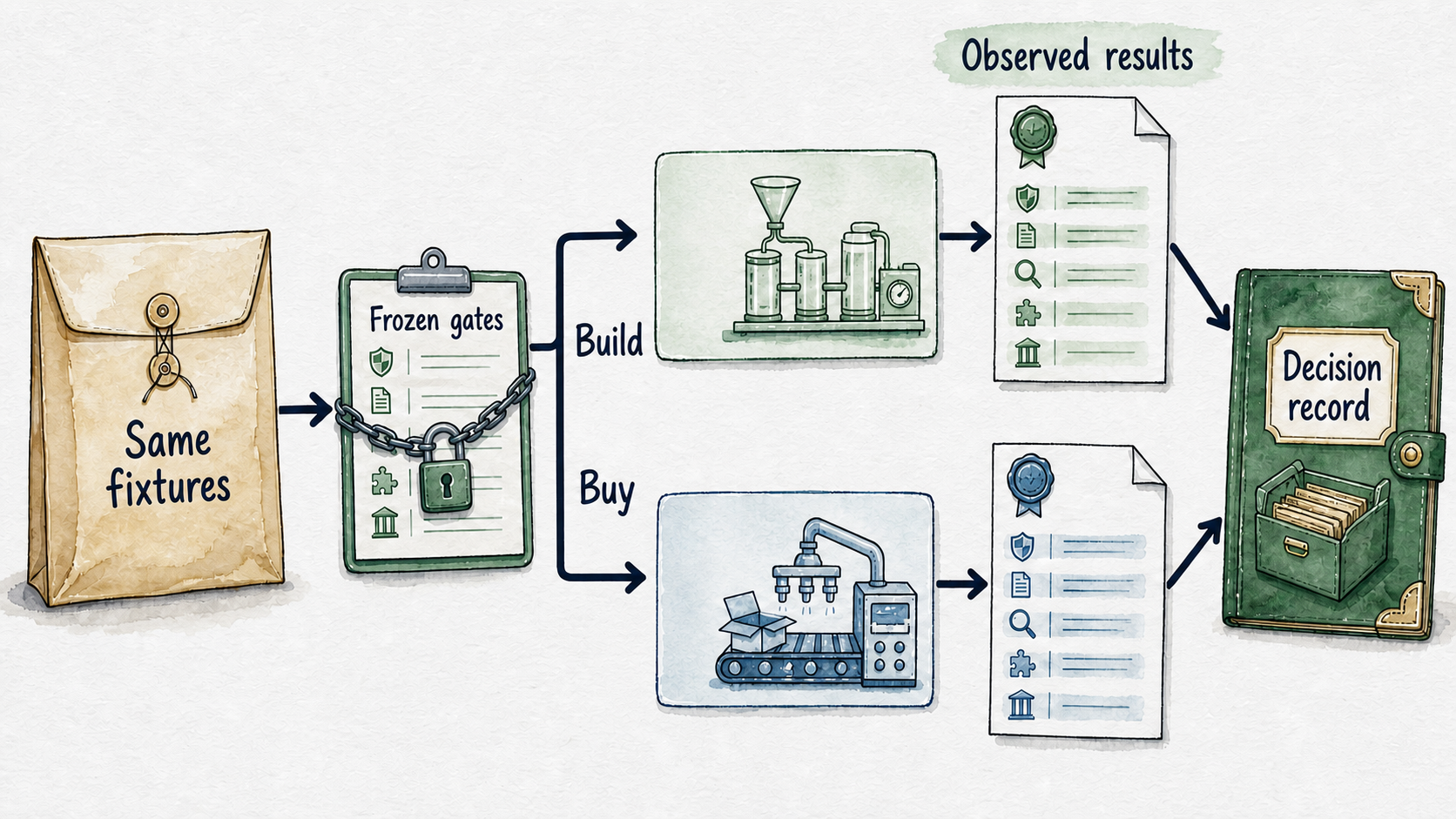
Classify every finding by evidence status:
- Documented fact: What the internal specification or provider contract states.
- Buyer input: A requirement, threshold, cost input, or ownership decision supplied by the buyer.
- Observed result: What happened during the dated test.
- Inference: A provisional interpretation that still needs confirmation.
- Unresolved gap: A question with neither adequate documentation nor a valid observation.
Do not claim that either path is faster, more accurate, more reliable, or easier to review before measuring both under the same conditions. The published guide titled “How to Test a Bank Statement Extraction API Before You Buy” owns the detailed fixture and scoring procedure. Its exact internal link should be inserted only when the publication contract permits that URL.
Record the Decision and the Conditions That Could Change It
Create an auditable decision record containing:
- The chosen path and rejected alternatives.
- The decision date and evidence dates.
- Every unresolved gap and its owner.
- Named owners for extraction, polling, retries, verification, review, mapping, deduplication, reconciliation, observability, security, and durable storage.
- References to the proof-of-concept results.
- The contract version and pricing evidence used.
- Reassessment triggers, including changes in volume, statement formats, retention rules, security requirements, vendor behavior, or accounting workflows.
Compare the API contract, then test with a synthetic statement. If every mandatory gate passes, proceed with a controlled pilot. If a gate fails, use that failure to define the requirement and ownership plan for another provider or an internal build.
FAQ
When should a small team build instead of buy?
Build when a mandatory requirement demands control that verified providers cannot supply and the team can own ongoing maintenance, layout changes, monitoring, incident response, review tooling, and security. A preference for control is incomplete without operating capacity.
When is a hybrid model appropriate?
Use hybrid when purchased OCR and extraction fit the contract but the product still needs its own normalization, review rules, accounting mapping, deduplication, reconciliation, or durable storage. Define the boundary explicitly so provider and buyer responsibilities are distinguishable.
Does buying an API eliminate human review?
No. The buyer must decide which outputs require review and who approves data before it reaches accounting records. Testing may inform a more targeted review policy, but it cannot be assumed in advance.
Who owns durable storage and accounting reconciliation?
The buyer does unless a verified contract explicitly transfers those responsibilities. Temporary JSON or spreadsheet results do not replace an approved system of record, duplicate controls, reconciliation, or final accounting review.
How should a buyer handle a missing public accuracy benchmark or processing-time SLA?
Treat both as unresolved questions. Request contractual clarification and measure the candidate with the buyer’s synthetic or properly authorized statement mix. Missing public evidence is neither proof of failure nor permission to assume acceptable performance.
How should build and buy paths be tested fairly?
Use identical synthetic or properly authorized fixtures, frozen requirements, and the same pass/fail gates. Date the run, preserve separate results for each path, and do not change the test set or acceptance rules after seeing a candidate’s output.